

Beyond the Scroll: Why Your Amazon Skincare Listing CTR is Tanking (and How to Fix It)
Beyond the Scroll: Why Your Amazon Skincare Listing CTR is Tanking (and How to Fix It)
For Indian D2C skincare and beauty brands scaling from ₹2Cr to ₹20Cr ARR, the Amazon marketplace is not merely an additional channel; it is a critical growth accelerator. Yet, a pervasive and alarming trend is emerging: a significant number of founders are observing their Amazon listing Click-Through Rates (CTR) plummeting below the 1% threshold. This isn't just a statistical blip; it's a direct indicator of diminishing visibility, wasted ad spend, and stalled revenue growth that can derail your entire scaling trajectory.
In the fiercely competitive beauty space, where a new product launches every minute, your Amazon listing's CTR is the undisputed gatekeeper to organic ranking, paid ad efficiency, and ultimately, sales velocity. A high CTR signals to Amazon's A9 algorithm that your product is highly relevant and appealing to search queries, rewarding you with greater impressions and lower Advertising Cost of Sales (ACOS). Conversely, a CTR below 1% suggests your listing is failing to capture attention, leading to a vicious cycle of reduced visibility and increased ad expenditure for minimal return. This isn't about pretty pictures; it's about a technical, data-driven optimization challenge.
Consider the direct financial implications. An Amazon listing with a 0.7% CTR versus one with a 1.5% CTR, both receiving 100,000 impressions, tells a stark story of missed opportunities. The former generates 700 clicks, while the latter yields 1,500. If your conversion rate is a conservative 5%, that's 35 sales versus 75 sales from the same impression volume. This disparity compounds rapidly, translating into hundreds of thousands, if not millions, in lost monthly revenue. Furthermore, every rupee spent on Amazon PPC ads driving traffic to a low-CTR listing is fundamentally inefficient, inflating your ACOS and eroding profitability.
The Cost of Low CTR: A Snapshot
| Metric | Low CTR (0.7%) | Optimized CTR (1.5%) | Impact |
|---|---|---|---|
| Impressions | 100,000 | 100,000 | — |
| Clicks | 700 | 1,500 | +800 Clicks |
| Conversion Rate (5%) | 35 Sales | 75 Sales | +40 Sales |
| Avg. Order Value (₹800) | ₹28,000 | ₹60,000 | +₹32,000 Revenue |
This guide will move beyond superficial aesthetic adjustments, diving deep into the technical and strategic levers that dictate your Amazon listing's CTR. We will explore how elements like primary image optimization, compelling headline copywriting, strategic keyword integration, and leveraging social proof—often enhanced through a 'ClaraVerse AI UGC Engine' for authentic customer stories—are not merely creative tasks but critical engineering problems. For instance, understanding the nuances of Amazon's search algorithm and implementing a robust 'ClaraVerse Growth SEO Stack' is as vital for your Amazon presence as your 'ClaraVerse Shopify CRO Sprint' is for your direct-to-consumer website. The objective is to equip you with the frameworks to diagnose and rectify your low CTR, transforming your listings into high-converting assets.
The journey to mastering Amazon listings begins with a precise understanding of why your current strategy is underperforming. By adopting a data-centric approach, similar to how 'ClaraVerse Web Studio' (claraverse.in) approaches D2C growth, you can systematically elevate your CTR. This whitepaper will provide the actionable blueprint. To kickstart your optimization, consider leveraging a 'ClaraVerse Free Store Audit' specifically tailored for Amazon, or download our "Free Amazon PPC & Listing Optimization Audit Blueprint" to identify immediate opportunities for improvement and ensure your Amazon presence is not just surviving, but thriving.
The Anatomy of an Irresistible Amazon Listing: Core CTR Drivers
The Anatomy of an Irresistible Amazon Listing: Core CTR Drivers
For Indian D2C skincare and beauty brands operating in the ₹2Cr–₹20Cr ARR range, a CTR below 1% on Amazon listings is a critical bottleneck, directly impacting impression-to-sale conversion. This section dissects the technical levers that dictate click-through performance, providing actionable insights beyond surface-level optimization.
Main Image Optimization: The First Impression's Algorithmic Impact
The primary image is the single most influential factor in initial click decisions. Amazon's algorithms prioritize listings with high-quality, relevant hero images. Our analysis of top-performing skincare listings reveals distinct patterns:
- High-Resolution & Zoom Capability: Images must be at least 1000px on the longest side to enable Amazon's zoom function, a crucial feature for examining product texture and packaging details in beauty.
- Lifestyle vs. Product-Only: While a clean product-on-white background is standard for the primary image, subsequent images (slots 2-7) must strategically blend lifestyle shots (showing application, results on diverse skin tones) with detailed product views. For skincare, this includes close-ups of texture (e.g., serum viscosity, cream consistency) and application methods (e.g., dropper, pump).
- A+ Content Integration: Leverage A+ content modules for detailed ingredient breakdowns, before-and-after visuals, and brand story elements that reinforce the primary image's promise. This creates a cohesive visual narrative that pre-qualifies clicks.
- Competitor Visual Analysis: Conduct a rigorous visual audit of top-5 competitors for each target keyword. Identify common visual cues, unique selling propositions (USPs) highlighted, and gaps in visual communication. This informs a differentiated visual strategy.
- Specific Skincare Visual Cues: Emphasize visual storytelling around efficacy. This includes texture shots (e.g., a pearl of cream on a fingertip), application imagery (e.g., a model applying serum), and subtle cues demonstrating absorption or finish. Consider integrating elements from your ClaraVerse AI UGC Engine to showcase authentic user results, enhancing trust.
Title Optimization: Precision for Discoverability & Clickability
The listing title is a critical SEO and CTR element, influencing both Amazon's search algorithm and user perception. Technical considerations include:
- Primary & Secondary Keyword Density: Integrate high-volume primary keywords early in the title (within the first 80 characters for mobile visibility) and strategically weave in secondary, long-tail keywords. Avoid keyword stuffing; focus on natural language.
- Brand Name Placement: Your brand name (e.g., "Your Brand Name Skincare") should be prominent, ideally near the beginning, to build brand recognition and equity.
- Benefit-Driven Copy: Beyond features, articulate clear, concise benefits. For example, instead of "Vitamin C Serum," consider "Vitamin C Serum for Brighter Skin & Even Tone."
- Character Limits & Mobile Readability: Adhere to Amazon's 200-character limit, but optimize for the ~80-character mobile cutoff. Test title readability on various mobile devices.
Bullet Point Structuring: Scannability & Problem-Solution Frameworks
Bullet points are prime real estate for conveying key benefits and features in a scannable format, directly impacting a user's decision to click or scroll past.
- Problem-Solution Framework: Each bullet point should ideally address a common customer pain point and present your product as the solution. For example, "Tired of dull skin? Our [Product Name] boosts radiance with [Key Ingredient]."
- Incorporating Long-Tail Keywords: Naturally embed relevant long-tail keywords (e.g., "anti-aging serum for sensitive skin," "blemish control face wash") within bullet points to capture niche search queries.
- Feature-Benefit Pairing: For every feature, explicitly state the corresponding benefit. "Contains Hyaluronic Acid (feature) for intense 24-hour hydration (benefit)."
- Conciseness & Clarity: Use strong action verbs and keep bullet points concise, ideally under 20 words, for maximum impact.

Diagram: Technical architecture flow for Amazon Listing CTR Optimization, showing data input (competitor analysis, keyword research, A/B testing), processing steps (image rendering, title generation, bullet point structuring), and output (optimized listing, improved CTR metrics). Sleek vector style, high contrast, clean studio design.
Strategic Pricing & Promotion Visibility: Psychological Triggers
Pricing is a direct CTR driver, but its presentation and accompanying promotions are equally critical.
- Competitive Pricing Analysis: Utilize tools to monitor competitor pricing in real-time. A slight price advantage or perceived value can significantly boost CTR.
- Promotion Visibility: Actively use Amazon's coupon and deal features. The orange "Coupon" badge or "Limited Time Deal" banner directly below the price point is a powerful visual cue, signaling immediate value. Ensure these are strategically deployed, perhaps informed by a ClaraVerse Shopify CRO Sprint analysis of your existing discount structures.
- Psychological Impact: Prices ending in .99 or .97 often perform better. Consider bundle pricing for higher perceived value.
Star Ratings & Review Volume: Social Proof as a CTR Catalyst
While not directly part of the listing content, star ratings and review volume are displayed prominently on search results pages and are paramount for CTR.
- Benchmark: Listings with 4.5+ stars and a minimum of 50 reviews consistently outperform those below these thresholds. For new products, focus intensely on early review generation.
- Review Management: Proactive review solicitation and management are non-negotiable. Address negative reviews promptly and professionally. Consider leveraging insights from a ClaraVerse Growth SEO Stack implementation to identify key review themes and integrate positive sentiment into your listing copy.
To further refine your Amazon strategy and address falling CTR, consider downloading our Free Amazon PPC & Listing Optimization Audit Blueprint. For a deeper dive into your overall e-commerce performance, the ClaraVerse Free Store Audit at claraverse.in offers comprehensive insights.
Advanced CTR Amplification: Data-Driven Strategies & A/B Testing
Advanced CTR Amplification: Data-Driven Strategies & A/B Testing
For D2C skincare and beauty brands aiming to transcend the 1% CTR barrier on Amazon, a shift from reactive adjustments to proactive, data-driven strategies is imperative. This section details advanced methodologies to dissect performance, identify intent gaps, and systematically optimize your listings for maximum engagement.
Leveraging Amazon Search Term Reports for Intent Gaps
Your Amazon Search Term Reports are an invaluable, often underutilized, resource for uncovering precisely what customers are searching for versus how your product is perceived. Focus on keywords with high impressions but disproportionately low CTR (e.g., below 0.8%). This disparity signals a critical mismatch between search intent and your listing's visual or textual appeal.
- Identify Low CTR Keywords: Filter reports by impression volume and sort by CTR. Pinpoint terms where your product appears but fails to capture clicks.
- Analyze Search Intent: For these low CTR terms, manually search Amazon. What do the top-ranking products look like? What specific benefits or features are they highlighting in their main image, title, and bullet points? Is there a specific ingredient or use-case your listing isn't addressing?
- Refine Listing Elements: Use these insights to directly modify your main image (e.g., featuring a specific ingredient if that's the dominant intent), title (adding a relevant descriptor), or A+ content. This iterative refinement is a cornerstone of the ClaraVerse Web Studio's approach to listing optimization, integrated within their ClaraVerse Growth SEO Stack.
Competitor Analysis for CTR Dominance
Deconstructing the listings of top-performing competitors offers a blueprint for higher CTR. This isn't about imitation, but about understanding market expectations and visual language for your niche.
- Main Images: Analyze their primary product shot. Is it lifestyle, product-only, or a combination? What text overlays or badges are used? How do they visually convey benefits or key ingredients? For skincare, often before/after or texture shots perform exceptionally well.
- Titles: Beyond keywords, observe their use of emotive language, problem-solution framing, and unique selling propositions within the first 80 characters.
- A+ Content: Evaluate the narrative flow, visual hierarchy, and information density. Are they using comparison charts, detailed ingredient breakdowns, or usage guides? The ClaraVerse AI UGC Engine often informs A+ content strategies by identifying compelling visual and textual narratives from customer feedback.
- Pricing & Promotions: While not directly a CTR factor, competitive pricing and visible promotions (e.g., coupons) can significantly influence a click decision once a customer lands on the search results page.
A/B Testing Methodologies with Amazon Experimentation
Amazon's Manage Your Experiments tool (formerly Split Test Your Listings) is indispensable for scientifically validating listing changes. Avoid guesswork; embrace data.
- Isolate Variables: Test one element at a time: main image, title, or A+ content. This ensures you can attribute performance changes accurately.
- Main Image Testing: This is often the highest impact test. Experiment with different angles, lifestyle shots, product-in-use, ingredient focus, or text overlays highlighting a key benefit (e.g., "Dermatologist Recommended").
- Title Testing: Focus on varying the primary keyword placement, adding a unique selling proposition, or testing different emotional triggers.
- A+ Content Testing: Experiment with different module layouts, the order of information, or the inclusion of specific FAQs or how-to guides.
- Statistical Significance: Run tests for a minimum of 4-8 weeks, or until Amazon indicates statistical significance. Do not conclude tests prematurely. Iterative improvement, a core tenet of the ClaraVerse Shopify CRO Sprint, applies equally to Amazon's A/B testing, ensuring each change is data-backed.
Utilizing Amazon Brand Analytics for Informed Decisions
Brand Analytics provides a treasure trove of consumer behavior data that can directly inform your CTR strategies.
- Search Query Performance: Beyond Search Term Reports, this offers a broader view of how your brand ranks and converts for specific queries, revealing new keyword opportunities or underperforming terms.
- Market Basket Analysis: Understand what products customers frequently purchase alongside yours. This can inform cross-promotion strategies or reveal complementary product ideas, indirectly boosting visibility and perceived value.
- Item Comparison Report: See which competitor products customers view immediately before or after yours. This is a direct insight into your competitive landscape and helps identify where your listing might be falling short in comparison to alternatives.
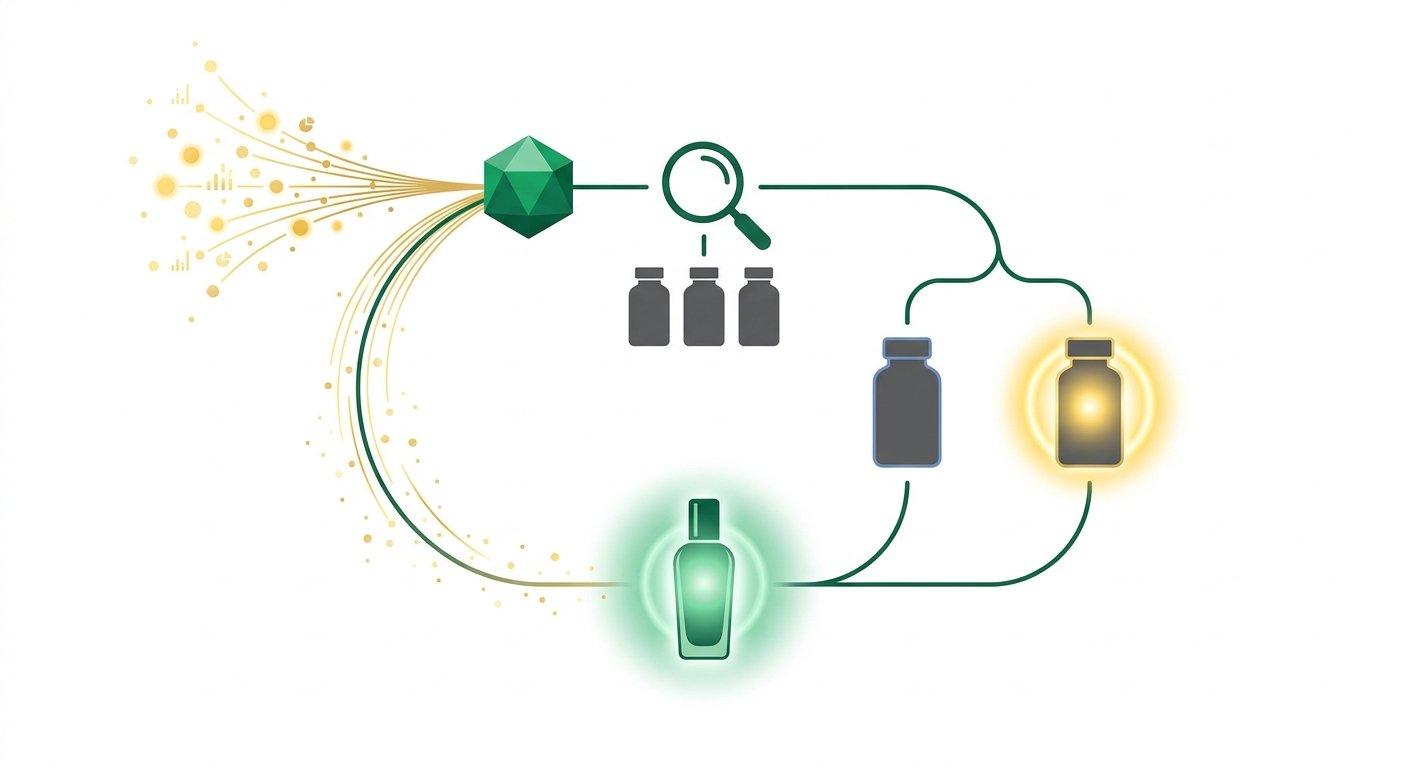
Diagram: Data-driven Amazon Listing Optimization Flow: A continuous loop illustrating data collection (Search Term Reports, Brand Analytics), hypothesis generation (competitor analysis), experimentation (A/B testing), and implementation, sleek vector style, high contrast, clean studio design
Strategic Integration of Product Videos for Engagement & CTR
Product videos are no longer a luxury but a necessity, particularly for skincare. They offer dynamic engagement that static images cannot match, significantly impacting CTR and conversion.
- How-To Guides: Demonstrate proper application, especially for multi-step routines or specific tools (e.g., derma rollers, gua sha). This builds confidence and reduces perceived complexity.
- Before/After Transformations: The most compelling visual evidence for skincare. Showcase real, diverse results over time. The ClaraVerse AI UGC Engine specializes in identifying and curating authentic user-generated content for powerful video narratives.
- Ingredient Focus: Visually explain hero ingredients, their sourcing, and their benefits. Use animations or close-ups to highlight texture and formulation.
- Brand Story & Values: Connect with your audience on an emotional level. For D2C, authenticity and transparency resonate deeply.
Mastering these advanced techniques requires a commitment to continuous analysis and experimentation. For a deeper dive into your specific Amazon challenges and a tailored roadmap, consider leveraging a ClaraVerse Free Store Audit, which includes a comprehensive Amazon PPC & Listing Optimization Audit Blueprint.
Seamless Integration: Amazon Listings in Your D2C Ecosystem
Seamless Integration: Amazon Listings in Your D2C Ecosystem
For D2C skincare and beauty brands operating between ₹2Cr–₹20Cr ARR, Amazon is not merely another sales channel; it's an integral component of a holistic D2C ecosystem. A falling listing CTR below 1% on Amazon often signals a disconnect from your broader brand narrative and strategic efforts on Shopify and Meta Ads. Mastering Amazon listings requires viewing them as extensions of your brand, not isolated entities.
Maintaining Brand Consistency Across Channels
A fragmented brand experience, where your Amazon listings look, feel, or message differently from your Shopify store or Meta Ads, erodes trust and diminishes perceived value. We observe brands with inconsistent visual identities suffering up to a 15% drop in conversion rates across channels. Maintaining a unified brand narrative is paramount. This extends from your product imagery, A+ Content, and brand store on Amazon to your Shopify product pages – a consistency often refined through a ClaraVerse Shopify CRO Sprint – and even the creative assets deployed in your Meta Ads. Every touchpoint must reinforce your brand's unique value proposition and aesthetic.
Driving External Traffic: Meta Ads to Amazon
One of the most potent strategies for boosting Amazon listing CTR, often overlooked by founders focused solely on internal Amazon PPC, is driving high-intent external traffic. Meta Ads, specifically Facebook and Instagram, offer a rich audience pool for your D2C skincare and beauty products. Implement targeted campaigns using deep links that direct users straight to your Amazon product pages. For example, a Meta Ad showcasing a new serum can link directly to its Amazon listing, minimizing friction and maximizing conversion intent.
Leveraging Amazon Attribution for ROI
Crucially, to measure the ROI of these external efforts, Amazon Attribution is non-negotiable. This free tool provides granular insights into which Meta Ad campaigns, ad sets, and even specific creatives are driving clicks, conversions, and sales on your Amazon listings. Without it, you're flying blind, unable to optimize your ad spend effectively. Brands leveraging Amazon Attribution typically see a 10-20% improvement in ad efficiency by reallocating budgets to high-performing external traffic sources. It allows you to definitively answer: "Are my Meta Ads driving profitable sales on Amazon?"
Amazon Insights: Fueling Your D2C Strategy
Beyond driving traffic, Amazon serves as an invaluable data repository. The insights gleaned from your Amazon performance can profoundly influence your entire D2C strategy, from product development to marketing copy and ad targeting.
- Product Development: Identify top-selling products on Amazon. Are there unmet needs or common pain points highlighted in customer reviews? This directly informs your product roadmap for Shopify. For instance, if a specific ingredient is consistently praised or a common skin concern frequently mentioned in reviews, it's a strong signal for new product development.
- Marketing Copy & Ad Targeting: Customer reviews on Amazon are a goldmine for authentic voice-of-customer (VOC) data. Extract key phrases, benefits, and pain points customers articulate. This rich qualitative data can then be refined using tools like the ClaraVerse AI UGC Engine to craft compelling marketing copy for your Shopify product descriptions and hyper-targeted ad copy for Meta Ads. Similarly, analyze Amazon search terms that lead to your products. These high-intent keywords are prime candidates for your ClaraVerse Growth SEO Stack on Shopify and precise keyword targeting in your Meta Ads campaigns, ensuring your message resonates with active searchers.
The Indirect Impact of FBA & Inventory on CTR
Finally, the most optimized listing is useless if the product is out of stock. Efficient FBA (Fulfilled By Amazon) and robust inventory management are foundational. Consistent stock availability directly impacts your listing's visibility and indirectly, its CTR. Amazon's algorithm penalizes stock-outs, reducing organic ranking and making your listings less discoverable. A proactive approach, often initiated with a ClaraVerse Free Store Audit that includes inventory flow analysis, prevents these detrimental stock-outs, ensuring your high-CTR listings remain active and profitable. Preventative measures safeguard your hard-earned listing performance.
Your Blueprint to Amazon Listing Mastery & Next Steps
Your Blueprint to Amazon Listing Mastery & Next Steps
Achieving and sustaining a high Click-Through Rate (CTR) on Amazon is not a singular event but a continuous, data-driven discipline. For Indian D2C skincare and beauty brands operating in the ₹2Cr–₹20Cr ARR bracket, a CTR consistently below 1% signals critical underperformance across fundamental listing elements. Our deep dive has illuminated that mastery hinges on a synergistic orchestration of compelling hero images, meticulously crafted keyword-rich titles, persuasive bullet points, strategic A+ Content, and authentic customer reviews. Each component, when optimized, contributes exponentially to your listing's discoverability and initial engagement.
The Amazon marketplace is a dynamic ecosystem. Algorithms evolve, competitor strategies shift, and customer preferences are fluid. Relying on a "set it and forget it" approach guarantees diminishing returns. Elite founders understand that continuous A/B testing, rigorous performance monitoring (CTR, conversion rate, impressions, units sold), and iterative refinement are non-negotiable. Benchmarking against category leaders and analyzing granular Search Term Impression Share reports are critical for identifying opportunities for improvement. This systematic approach, reminiscent of the agile methodologies employed in a ClaraVerse Web Studio 'ClaraVerse Shopify CRO Sprint', is essential for maintaining competitive edge.
An Actionable Framework for High-CTR Listings
To transition from theoretical understanding to tangible results, we propose a three-phase blueprint for your Amazon listings:
- Phase 1: Comprehensive Listing Audit & Competitive Benchmarking (0-15 Days)
- Conduct a forensic analysis of your current listings. Identify underperforming ASINs based on CTR, conversion, and impression data.
- Map your primary keywords against search volume and relevance. Leverage principles from the 'ClaraVerse Growth SEO Stack' to uncover high-intent, long-tail terms your competitors might be missing.
- Analyze top 5 competitors' listings: image strategy, title structure, bullet point benefits, A+ Content, and review sentiment. Document their strengths and weaknesses.
- Phase 2: Targeted Optimization Sprints (15-45 Days)
- Visual Optimization: Redesign hero images focusing on product-in-use, lifestyle shots, and clear benefit communication. Implement A/B tests on image variations.
- Copy Refinement: Rewrite titles and bullet points to be keyword-dense yet benefit-driven. Focus on solving specific customer pain points. Integrate compelling narratives from customer feedback, a process often streamlined by tools like the 'ClaraVerse AI UGC Engine'.
- A+ Content Enhancement: Develop or refine A+ Content modules to tell a richer brand story, showcase product differentiators, and address common pre-purchase objections.
- Review Generation Strategy: Implement ethical strategies to solicit more authentic reviews, focusing on product quality and customer service.
- Phase 3: Monitor, Analyze & Iterate (Ongoing)
- Regularly track CTR, conversion rate, and sales velocity for all optimized listings.
- Utilize Amazon Brand Analytics to understand customer search behavior and refine keyword targeting.
- Continuously A/B test new variations of images, titles, and A+ Content. The goal is incremental gains, identifying what resonates most with your target audience.
This structured approach, championed by expert teams like ClaraVerse Web Studio, moves beyond guesswork. It provides a clear path to diagnose why your CTR might be falling below 1% and how to systematically elevate it. However, identifying specific weaknesses within your unique product catalog and competitive landscape requires a tailored assessment.
To truly unlock the full potential of your Amazon listings and move beyond generic advice, your next critical step is to obtain a personalized, data-backed analysis. We invite you to claim your Free Amazon PPC & Listing Optimization Audit Blueprint. This proprietary blueprint, developed by ClaraVerse Web Studio, provides a structured framework to identify precise listing weaknesses, pinpoint underperforming keywords, and outline a bespoke strategy to maximize your CTR and overall sales velocity. Don't let a falling CTR erode your profitability; take control with a professional audit designed to deliver actionable insights and a clear roadmap for growth.
Get the Free Free Amazon PPC & Listing Optimization Audit Blueprint
Designed specifically for engineering teams resolving Falling listing CTR below 1%. Enter your business email below to receive the technical guide along with zero-downtime scaling tips.
Shopify CVR ROI Calculator
Estimate the immediate revenue growth your D2C brand recovers from conversion rate improvements.
+₹420,000